Relay Interface Status Indicator Lights RS232 RS485 RS422POE
2024-12-01
-
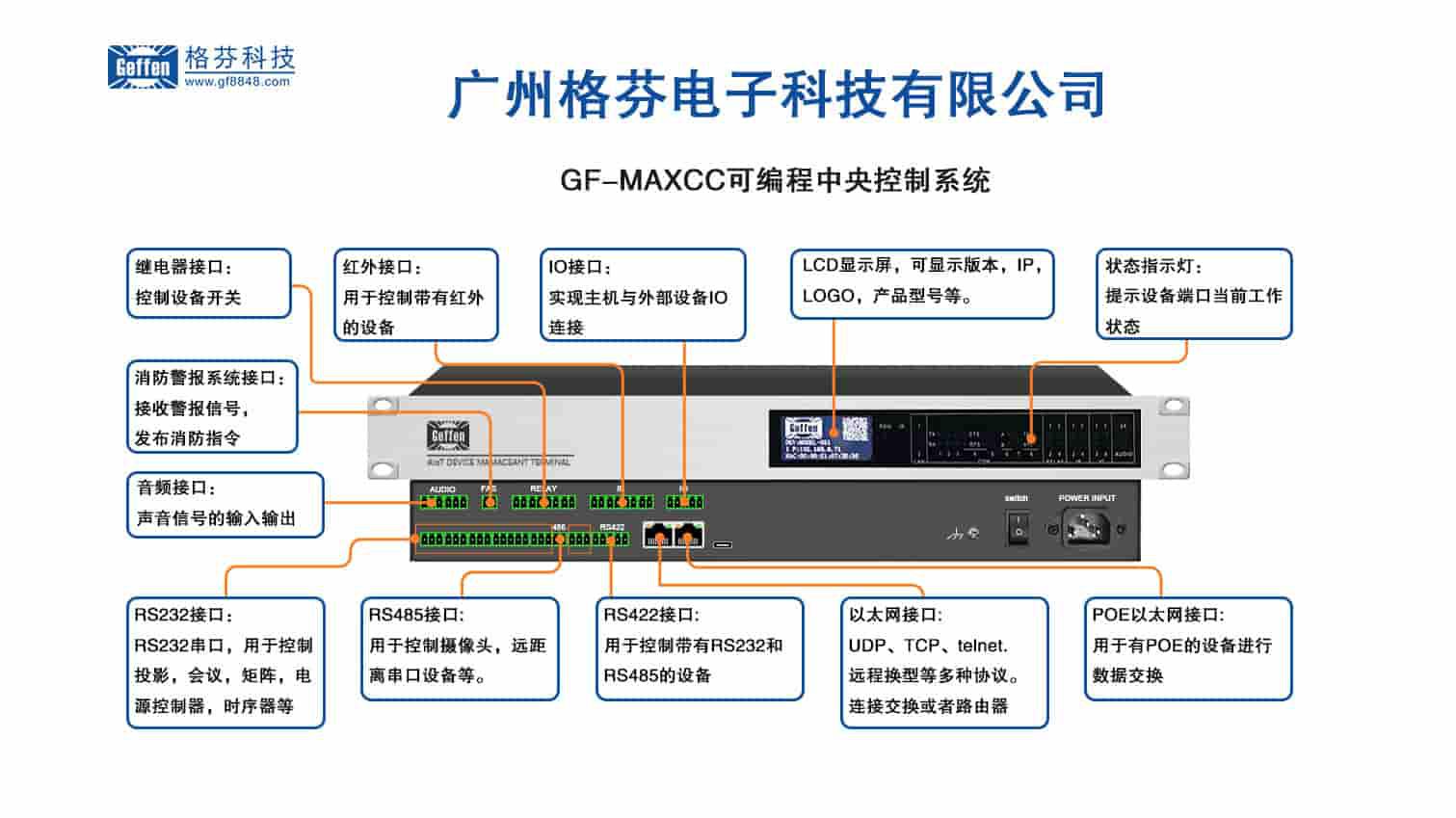
Relay Interface
-
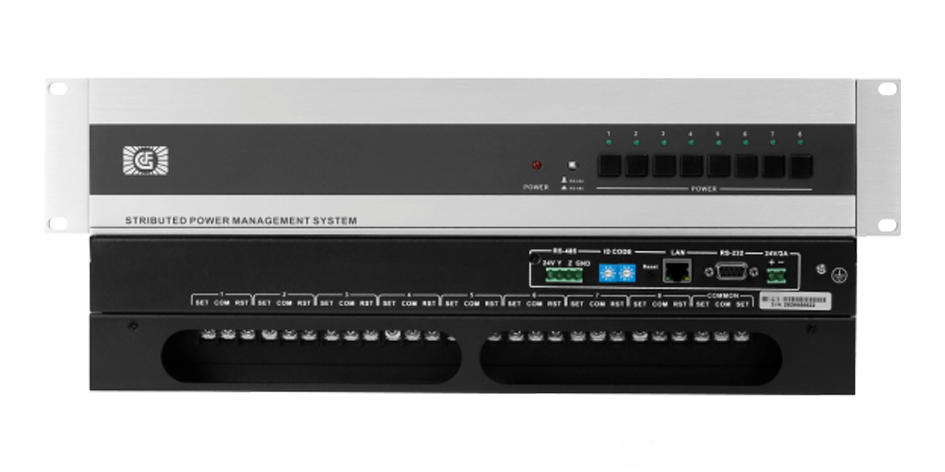
Composition: It usually consists of multiple relay channels, and each channel can be controlled independently. A relay is an electrical control device with a control coil and contacts. It realizes the closing or opening of the contacts by controlling the current of the coil, thereby controlling the on - off of the external circuit.
-
Function: It's mainly used to control high - power equipment such as lighting systems, electric curtains, and electric projection screens. When the control host sends an instruction through a program, the relay interface makes the corresponding relay act according to the instruction. For example, at the beginning of a meeting, the control host sends a light - on command, and the relay interface closes the relay connected to the lighting circuit, and the lights turn on; at the end of the meeting, a light - off command is sent, and the relay opens, and the lights go out. Because the relay can achieve weak - current control of high - current, it effectively isolates the weak - current part of the central - control system and high - power equipment, ensuring the safety of the system.
-
Infrared Interface
-
Composition: It includes an infrared - emitting diode and related driving circuits. The infrared - emitting diode can convert electrical signals into infrared light signals and emit them outward. Some systems are also equipped with an infrared receiver for learning infrared signals.
-
Function: It's used to control devices with infrared remote - control functions, such as televisions, DVD players, set - top boxes, and some brands of air - conditioners. The central - control system realizes control by emitting the same infrared signal as the original remote - control of the device through the infrared interface. For example, before playing the content of a video conference, the television is turned on and set to the specified channel or input source by sending a signal through the infrared interface. At the same time, the learning function of the infrared interface allows the central - control system to remember the infrared signal code of the remote - control of a new device, enabling it to be compatible with more devices.
-
IO Interface (Input/Output Interface)
-
Composition: It consists of digital input pins and digital output pins, and each pin has a corresponding circuit for signal processing and level conversion.
-
Function: The digital input pins can be connected to external sensors, such as door - magnetic sensors and human - body infrared sensors. When the state of the sensor changes, the corresponding input pin will receive a signal and then transmit it to the control host. For example, when someone enters the meeting room, the human - body infrared sensor detects the signal and informs the control host through the IO input pin, and the control host can automatically turn on the lighting and other equipment according to the pre - programmed settings. The digital output pins can be used to control some simple digital devices, such as small - sized indicator lights.
-
LCD Display Screen
-
Composition: It's composed of a liquid - crystal display panel, a backlight module, and a driving circuit. The liquid - crystal display panel displays images and text through the arrangement change of liquid - crystal molecules, the backlight module provides the light source required for display, and the driving circuit is responsible for receiving the signals from the control host and controlling the content displayed on the liquid - crystal display.
-
Function: It's used to display relevant information of the conference central - control system, such as device status, current scene mode, and time. For example, you can intuitively see whether the projector is on and what the light - brightness level is on the screen. At the same time, it can also be used as an operation - prompt interface to guide users to perform correct system operations. For example, when switching the scene mode, it displays the currently - executing operation steps.
-
QR Code Display
-
Composition: It mainly consists of a display screen (usually a small - sized liquid - crystal display screen or an electronic - ink screen) and a control circuit for generating QR codes.
-
Function: It's used to display QR - code information, which is convenient for users to scan with mobile devices to obtain conference - related materials, such as meeting agendas, file - download links, and device - use instructions. It can also be used for device pairing or network - connection settings. For example, users scan the QR code to connect to the Wi - Fi hotspot of the central - control system or authorize remote - control of devices.
-
Status Indicator Lights
-
Composition: It's generally composed of multiple light - emitting diodes (LEDs), and each LED corresponds to a different device or system state. The color and flashing mode of the LEDs can vary according to the design.
-
Function: It intuitively displays the current state of the system or device. For example, a constantly - lit green indicator light indicates that the device is operating normally, and a red - flashing light may indicate that the device has a malfunction or an operation is waiting to be processed. For example, when the projector is warming up, the corresponding status - indicator light may flash yellow, and after warming up, it turns into a constantly - lit green light.
-
Fire - Alarm - System Interface
-
Composition: It includes a signal - input interface and a linkage - output interface. The signal - input interface is used to receive alarm signals from fire - alarm equipment (such as smoke detectors and fire alarms), and the linkage - output interface is used to control other related equipment.
-
Function: When the fire - alarm system triggers an alarm, the fire - alarm - system interface receives the signal, and the control host can perform emergency operations according to the preset program. For example, it immediately cuts off the power supply of all non - essential electrical equipment (such as lights, projectors, etc.), turns on the emergency - lighting equipment at the same time, and activates the emergency - evacuation - broadcast system to ensure the safety of personnel and the fire - emergency response.
-
Audio Interface
-
Composition: There are audio - input interfaces and audio - output interfaces. The audio - input interfaces include microphone - input interfaces (which may be XLR interfaces, 3.5 - mm interfaces, etc.) and are used to receive sound signals from audio - acquisition devices such as microphones; the audio - output interfaces (such as RCA interfaces, RCA - phono - plug interfaces, 3.5 - mm interfaces, etc.) are used to connect audio - playing devices such as speakers and power amplifiers. It may also include an audio - processing circuit for amplifying, mixing, and equalizing audio signals.
-
Function: It realizes the audio - acquisition and - playing functions in the conference. The microphone collects the speaker's voice, transmits it to the central - control system through the audio - input interface, and after processing, transmits it to the speaker for playing through the audio - output interface. Audio parameters can be adjusted according to the conference scene, such as adjusting the volume and the mixing ratio, to obtain a good sound effect.
-
RS232 Interface
-
Composition: It mainly consists of a transmit - data pin (TXD), a receive - data pin (RXD), and a ground pin (GND). Some may also include control pins. It's connected to the RS232 interface of other devices through a cable for serial communication.
-
Function: It's used to connect professional audio - video equipment and industrial - control equipment, such as high - end projectors, matrix switchers, and some brands of cameras. It can achieve in - depth control of these devices, including device - parameter settings (such as the brightness, contrast, and color parameters of the projector), device - state inquiries (such as inquiring about the bulb - usage time of the projector), and complex operations (such as signal - source switching of the matrix switcher).
-
RS485 Interface
-
Composition: It has the characteristic of differential - signal transmission and consists of two signal lines A and B and a ground wire. Multiple devices can be connected on the bus, and different devices are distinguished by address codes.
-
Function: It's mainly used for long - distance and multi - device communication. In some large - scale conference systems, it can be used to connect multiple distributed devices, such as multiple cameras or distributed audio processors. It can achieve high - speed and stable communication, has a long transmission distance, generally up to the kilometer level, and has strong anti - interference ability.
-
RS422 Interface
-
Composition: It's also based on differential - signal transmission and has four signal lines: transmit positive (TX +), transmit negative (TX -), receive positive (RX +), receive negative (RX -), and a ground wire. It has a higher transmission speed and a longer transmission distance than the RS232 interface.
-
Function: It's suitable for connecting devices with high requirements for communication speed and distance. For example, in a large - scale conference venue, it's used to connect remote stage - equipment - control systems or long - distance video - signal - transmission devices to ensure stable and efficient communication.
-
Ethernet Interface
-
Composition: It's usually an RJ45 interface, internally connected to a network controller, and supports different transmission rates such as 10/100/1000Mbps.
-
Function: It realizes the network connection of the central - control system. Through the Ethernet interface, the central - control system can be connected to a local - area network or the Internet. In this way, remote control can be carried out. For example, users can remotely operate the equipment in the meeting room through software on their mobile phones or computers in the office or other places. At the same time, it's also convenient for the system to update software, manage equipment, and transmit data, such as uploading or downloading meeting records.
-
POE Interface (Power over Ethernet Interface)
-
Composition: Based on the Ethernet interface (RJ45), it integrates the power - supply function. It transmits data and power through a network cable at the same time.
-
Function: It provides power and network connection for POE - supported devices (such as some network cameras and wireless - access points). This can reduce the complexity of wiring because there is no need to lay a separate power cable for these devices. As long as there is a POE network cable, the power supply and networking of the device can be realized, which is especially suitable for meeting places where equipment needs to be installed flexibly.








 :Building 3, Baizhong Creative Park, No. 240 Shilian Road, Panyu District, Guangzhou,Guangdong,China
 :
: :+86 20-34702140